
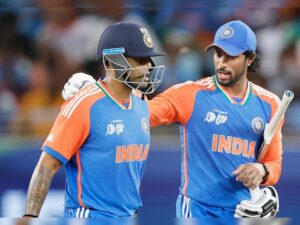
India captain Suryakumar Yadav has confirmed that the Indian cricket team’s decision to skip post-match handshakes with Pakistan was deliberate and in line with guidance from the Board of Control for Cricket in India (BCCI) and the Indian government. The move followed India’s emphatic seven-wicket win over Pakistan in their Group A Asia Cup match held in Dubai.
The Match & Context
India chased down Pakistan’s modest target with ease, sealing a seven-wicket victory. The game unfolded without major controversy on the field—but tensions emerged after the final delivery, when the customary post-match handshake did not take place.
This match was also played against the backdrop of recent events: the Pahalgam terror attack in April 2025, which claimed the lives of 26 civilians. With strong public sentiments in India following the tragedy, the match carried more emotional weight than usual.
What India’s Captain Says
In his post-match media interactions, Suryakumar expressed that:
The decision to forgo handshakes was a team call. India’s players acted under alignment with the BCCI and government directives.
The gesture was not meant to disrespect the spirit of the game, but to show solidarity with the victims of the Pahalgam attack and to honour India’s armed forces.
“Some things in life are ahead of sportsmanship,” he stated, indicating that while sportsmanship is important, certain national events and emotions may demand different expressions.
Reactions & Fallout
Pakistan’s head coach Mike Hesson voiced disappointment. He said that Pakistan was ready to shake hands at the game’s conclusion, but the Indian players had already headed to the changing rooms.
Pakistan captain Salman Ali Agha did not attend the presentation ceremony, which drew further attention. It was seen as a response to the handshake snub.
Mohsin Naqvi, Chairman of the Pakistan Cricket Board and the Asian Cricket Council (ACC), criticized India’s stance, calling it a violation of the spirit of cricket and urging that politics not be carried onto the field.
Implications & What to Watch Ahead
This incident further highlights how cricket matches between India and Pakistan are influenced by political and emotional contexts, beyond just the sporting rivalry.
Media and public discourse has been sharply divided. Some support India’s decision as a symbolic stand; others argue that sportsmanship should transcend politics.
Asia Cup organisers and governing bodies like the ACC may face pressure to clarify or reconsider protocols around such gestures.
Future matches, especially if India and Pakistan meet again in the Super Four or final, may come under more intense scrutiny regarding pre- and post-match formalities.
India’s win over Pakistan in Asia Cup 2025 was not just a cricketing result: it has become a moment of symbolism, national sentiment, and debate over what constitutes sportsmanship when the backdrop is charged with recent tragedies.